How to Draw a Plane Shoots Bombs

A bomber is a armed forces gainsay aircraft designed to attack ground and naval targets past dropping air-to-ground weaponry (such as bombs), launching torpedoes, or deploying air-launched cruise missiles. The first use of bombs dropped from an aircraft occurred in the Italo-Turkish War, with the first major deployments coming in the First Earth War and Second Globe War past all major airforces causing devastating harm to cities, towns, and rural areas. The showtime purpose built bombers were the Italian Caproni Ca xxx and British Bristol T.B.8, both of 1913. Some bombers were busy with nose fine art or victory markings.
There are two major classifications of bomber: strategic and tactical. Strategic bombing is done by heavy bombers primarily designed for long-range bombing missions against strategic targets to diminish the enemy's ability to wage war past limiting access to resources through crippling infrastructure or reducing industrial output. Tactical bombing is aimed at countering enemy military activity and in supporting offensive operations, and is typically assigned to smaller aircraft operating at shorter ranges, typically near the troops on the footing or against enemy aircraft.
During WWII with engine ability as a major limitation, combined with the desire for accuracy and other operational factors, bomber designs tended to be tailored to specific roles. Early in the Cold War however, bombers were the merely means of carrying nuclear weapons to enemy targets, and held the part of deterrence. With the advent of guided air-to-air missiles, bombers needed to avoid interception. High-speed and loftier-distance flight became a means of evading detection and attack. With the advent of ICBMs the part of the bomber was brought to a more tactical focus in close air support roles, and a focus on stealth technology for strategic bombers.
Nomenclature [edit]
Strategic [edit]

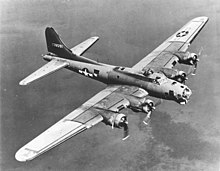
Strategic bombing is done by heavy bombers primarily designed for long-range bombing missions confronting strategic targets such equally supply bases, bridges, factories, shipyards, and cities themselves, to diminish the enemy's ability to wage war by limiting access to resource through crippling infrastructure or reducing industrial output. Current examples include the strategic nuclear-armed bombers: B-2 Spirit, B-52 Stratofortress, Tupolev Tu-95 'Comport', Tupolev Tu-22M 'Backfire' and Tupolev Tu-160 "Blackjack"; historically notable examples are the: Gotha M.Iv, Avro Lancaster, Heinkel He 111, Junkers Ju 88, Boeing B-17 Flying Fortress, Consolidated B-24 Liberator, Boeing B-29 Superfortress, and Tupolev Tu-sixteen 'Badger'.
Tactical [edit]
Tactical bombing, aimed at countering enemy armed services activeness and in supporting offensive operations, is typically assigned to smaller aircraft operating at shorter ranges, typically virtually the troops on the ground or confronting enemy shipping. This role is filled past tactical bomber class, which crosses and blurs with various other aircraft categories: calorie-free bombers, medium bombers, dive bombers, interdictors, fighter-bombers, attack shipping, multirole combat shipping, and others.
- Current examples: Xian JH-vii, Dassault-Breguet Delusion 2000D, and the Panavia Tornado IDS
- Historical examples: Ilyushin Il-2 Shturmovik, Junkers Ju 87 Stuka, Republic P-47 Thunderbolt, Hawker Typhoon and Mikoyan MiG-27.
History [edit]
The showtime employ of an air-dropped flop (really four paw grenades specially manufactured by the Italian naval armory) was carried out past Italian Second Lieutenant Giulio Gavotti[i] on 1 November 1911 during the Italo-Turkish state of war in Libya – although his airplane was non designed for the task of bombing, and his improvised attacks on Ottoman positions had piddling touch on. These picric acid-filled steel spheres were nicknamed "ballerinas" from the fluttering fabric ribbons attached.[2]
Early on bombers [edit]

On 16 Oct 1912, observer Prodan Tarakchiev dropped two of those bombs on the Turkish railway station of Karağaç (virtually the besieged Edirne) from an Albatros F.ii aircraft piloted by Radul Milkov, for the first time in this campaign.[3] [iv] This is deemed to be the first utilise of an aircraft every bit a bomber.[3] [5]
The first heavier-than-air shipping purposely designed for bombing were the Italian Caproni Ca 30 and British Bristol T.B.eight, both of 1913.[6] The Bristol T.B.eight was an early on British unmarried engined biplane congenital by the Bristol Aeroplane Company. They were fitted with a prismatic Bombsight in the front cockpit and a cylindrical flop carrier in the lower forward fuselage capable of carrying twelve 10 lb (4.5 kg) bombs, which could be dropped singly or as a salvo as required.[seven]
The aircraft was purchased for apply both by the Royal Naval Air Service and the Purple Flying Corps (RFC), and iii T.B.8s, that were being displayed in Paris during December 1913 fitted with bombing equipment, were sent to France following the outbreak of state of war. Under the control of Charles Rumney Samson, a bombing attack on German gun batteries at Middelkerke, Belgium was executed on 25 November 1914.[8] [9]
The dirigible, or airship, was developed in the early 20th century. Early airships were prone to disaster, but slowly the balloon became more undecayed, with a more than rigid structure and stronger peel. Prior to the outbreak of war, Zeppelins, a larger and more streamlined grade of airship designed past German Count Ferdinand von Zeppelin, were outfitted to conduct bombs to attack targets at long range. These were the first long range, strategic bombers. Although the German language air arm was potent, with a full of 123 airships by the end of the state of war, they were vulnerable to assail and engine failure, as well every bit navigational issues. German airships inflicted little damage on all 51 raids, with 557 Britons killed and i,358 injured. The German Navy lost 53 of its 73 airships, and the German Army lost 26 of its fifty ships.[10]
The Caproni Ca 30 was built past Gianni Caproni in Italian republic. It was a twin-boom biplane with iii 67 kW (lxxx hp) Gnome rotary engines and first flew in October 1914. Exam flights revealed power to exist insufficient and the engine layout unworkable, and Caproni soon adopted a more than conventional approach installing iii 81 kW (110 hp) Fiat A.10s. The improved blueprint was bought by the Italian Army and it was delivered in quantity from August 1915.
While mainly used as a trainer, Avro 504s were also briefly used as bombers at the start of the First Earth State of war past the Imperial Naval Air Service (RNAS) when they were used for raids on the German language balloon sheds.[eleven]
Strategic bombing [edit]
Bombing raids and interdiction operations were mainly carried out past French and British forces during the War as the German air arm was forced to concentrate its resources on a defensive strategy. Notably, bombing campaigns formed a office of the British offensive at the Battle of Neuve Chapelle in 1915, with Imperial Flight Corps squadrons attacking German language railway stations in an attempt to hinder the logistical supply of the German army. The early, improvised attempts at bombing that characterized the early on part of the war slowly gave way to a more organized and systematic approach to strategic and tactical bombing, pioneered by various air power strategists of the Entente, particularly Major Hugh Trenchard; he was the offset to advocate that there should be "... sustained [strategic bombing] attacks with a view to interrupting the enemy'south railway communications ... in conjunction with the master operations of the Centrolineal Armies."[6]
When the war started, bombing was very crude (hand-held bombs were thrown over the side) yet by the end of the war long-range bombers equipped with complex mechanical bombing computers were existence built, designed to carry large loads to destroy enemy industrial targets. The most of import bombers used in World War I were the French Breguet 14, British de Havilland DH-4, German language Albatros C.Three and Russian Sikorsky Ilya Muromets. The Russian Sikorsky Ilya Muromets, was the first 4-engine bomber to equip a dedicated strategic bombing unit during World War I. This heavy bomber was unrivaled in the early on stages of the war, equally the Central Powers had no comparable aircraft until much later.
Long range bombing raids were carried out at nighttime by multi-engine biplanes such equally the Gotha Yard.IV (whose proper noun was synonymous with all multi-engine German bombers) and afterward the Handley Folio Blazon O; the majority of bombing was done by unmarried-engined biplanes with one or two coiffure members flying short distances to attack enemy lines and immediate hinterland. Every bit the effectiveness of a bomber was dependent on the weight and accuracy of its bomb load, e'er larger bombers were adult starting in World State of war I, while considerable money was spent developing suitable bombsights.
Globe War 2 [edit]
With engine power as a major limitation, combined with the desire for accuracy and other operational factors, bomber designs tended to exist tailored to specific roles. Past the start of the war this included:
- dive bomber – specially strengthened for vertical diving attacks for greater accuracy
- light bomber, medium bomber and heavy bomber – subjective definitions based on size
- torpedo bomber – specialized aircraft armed with torpedoes
- ground attack shipping – aircraft used against targets on a battlefield such as troop or tank concentrations
- dark bomber – specially equipped to operate at night when opposing defences are express
- maritime patrol – long range bombers that were used against enemy aircraft, especially submarines
- fighter-bomber – a modified fighter aircraft used equally a low-cal bomber
Bombers are non intended to attack other aircraft although near were fitted with defensive weapons. World War II saw the starting time of the widespread use of high speed bombers which dispensed with defensive weapons to be able to attain higher speed, such as with the de Havilland Mosquito, a philosophy that continued with many Cold War bombers.
Some smaller designs have been used as the footing for nighttime fighters, and a number of fighters, such every bit the Hawker Hurricane were used as footing set on aircraft, replacing earlier conventional lite bombers that proved unable to defend themselves while carrying a useful bomb load.
Common cold War [edit]

At the commencement of the Cold War, bombers were the only means of carrying nuclear weapons to enemy targets, and had the function of deterrence. With the advent of guided air-to-air missiles, bombers needed to avoid interception. Loftier-speed and loftier-distance flying became a means of evading detection and attack. Designs such as the English Electric Canberra could fly faster or higher than contemporary fighters. When surface-to-air missiles became capable of hitting loftier-flying bombers, bombers were flown at low altitudes to evade radar detection and interception.
Once "stand off" nuclear weapon designs were developed, bombers did not need to pass over the target to make an set on; they could burn down and turn away to escape the blast. Nuclear strike aircraft were generally finished in bare metal or anti-wink white to minimize assimilation of thermal radiation from the flash of a nuclear explosion. The need to drop conventional bombs remained in conflicts with non-nuclear powers, such as the Vietnam War or Malayan Emergency.
The evolution of large strategic bombers stagnated in the subsequently role of the Cold War because of spiraling costs and the development of the Intercontinental ballistic missile (ICBM) – which was felt to have similar deterrent value while being impossible to intercept. Because of this, the U.s.a. Air Force XB-70 Valkyrie program was cancelled in the early on 1960s; the subsequently B-1B Lancer and B-2 Spirit aircraft entered service only later on protracted political and development problems. Their high cost meant that few were built and the 1950s-designed B-52s are projected to remain in utilise until the 2040s. Similarly, the Soviet Union used the intermediate-range Tu-22M 'Backlash' in the 1970s, merely their Mach 3 bomber project stalled. The Mach 2 Tu-160 'Blackjack' was congenital only in tiny numbers, leaving the 1950s Tupolev Tu-16 and Tu-95 'Bear' heavy bombers to continue existence used into the 21st century.
The British strategic bombing force largely came to an end when the 5 bomber strength was phased out; the last of which left service in 1983. The French Delusion IV bomber version was retired in 1996, although the Mirage 2000N and the Rafale accept taken on this role. The only other nation that fields strategic bombing forces is Cathay, which has a number of Xian H-6s.

Modern era [edit]
Currently, simply the Us Air Force, the Russian Aerospace Forces' Long-Range Aviation control, and China'due south People's Liberation Ground forces Air Force operate strategic heavy bombers. Other air forces accept transitioned abroad from dedicated bombers in favor of multirole combat aircraft.
At present, these air forces are each developing stealth replacements for their legacy bomber fleets, the USAF with the Northrop Grumman B-21, the Russian Aerospace Forces with the PAK DA, and the PLAAF with the Xian H-20. As of 2021[update], the B-21 is expected to enter service past 2026–2027.[12] The B-21 would be capable of loitering virtually target areas for extended periods of time.[xiii]
Other uses [edit]
Occasionally, military shipping have been used to bomb ice jams with limited success every bit role of an endeavor to articulate them.[14] [15] [xvi] In 2018, the Swedish Air Force dropped bombs on a forest burn, snuffing out flames with the aid of the blast waves. The fires had been raging in an area contaminated with unexploded ordnance, rendering them difficult to extinguish for firefighters. [17]
See as well [edit]
- Aerial bombing of cities
- Air interdiction
- Assembly send
- Rug bombing
- Fighter aircraft
- List of bomber aircraft
- Offensive counter air
- Strategic bomber
References [edit]
- ^ Johnston, Alan (ten May 2011). "Great socialist people's libyan arab jamahiriya 1911: How an Italian airplane pilot began the air war era". BBC News. Archived from the original on 13 May 2011. Retrieved 23 May 2011.
- ^ Stephenson, Charles. A Box of Sand. The Italo-Ottoman War 1911-12. p. 107. ISBN978-0-9576892-two-0.
- ^ a b Capt Arthur H. Wagner Uscg (Ret), Arthur H. Wagner, Leon Due east. Braxton, Ltcol Leon E. (Bill) (2012). Nascence of a Legend. Trafford Publishing. p. 27. Archived from the original on 2016-04-26. Retrieved 2015-07-28 . [ self-published source ]
- ^ "The Balkan Wars: Scenes from the Front Lines". TIME. 8 October 2012. Archived from the original on 27 March 2016. Retrieved 28 July 2015.
- ^ I.Borislavov, R.Kirilov: The Bulgarian Aircraft, Vol.I: From Bleriot to Messerschmitt. Litera Prima, Sofia, 1996 (in Bulgarian)
- ^ a b Mark (July 1995). Aeriform Interdiction: Air Power and the Land Battle in Iii American Wars. pp. 9–10. ISBN978-0-7881-1966-8. Archived from the original on 2016-05-01. Retrieved 2015-10-29 .
- ^ Stonemason, Francis K (1994). The British Bomber since 1914. London: Putnam Aeronautical Books. ISBN0-85177-861-5.
- ^ Taylor, Michael J. H. (1989). Jane's Encyclopedia of Aviation. London: Studio Editions. p. 204.
- ^ Thetford, Owen (1994). British Naval Aircraft since 1912 (Quaternary ed.). London: Putnam. ISBN0-85177-861-5.
- ^ Roadman, LTC Julian A. (2013). A Gainsay Nightmare in WWII. Triumph Press. pp. 11–12. ISBN9781484911846.
- ^ Mason, Francis K. The British Bomber since 1914. London: Putnam Aeronautical Books, 1994. ISBN 0-85177-861-v. p.21
- ^ D'Urso, Stefano (January 17, 2021). "Second B-21 Raider Nether Construction every bit the Start One Approaches Roll-Out in Early 2022". The Aviationist. Retrieved Feb 5, 2021.
- ^ "Persistence in 2018 bomber". Archived from the original on 2008-09-05. Retrieved 2009-06-04 .
- ^ Smith, Stephen H. (January xix, 2018). "York'south Past: Aeriform bombing breaks Susquehanna water ice jams". The York Daily Tape . Retrieved 2018-07-nineteen .
- ^ Daniszewski, John (2001-05-18). "Russian Planes Flop Ice Jam". Los Angeles Times. ISSN 0458-3035. Archived from the original on 2015-12-04. Retrieved 2018-07-19 .
- ^ Sridharan, Vasudevan (2016-04-19). "Russian fighter jets flop 40km water ice-jam to preclude flooding in Vologda". International Business Times UK. Archived from the original on 2018-07-xix. Retrieved 2018-07-xix .
- ^ Mizokami, Kyle (July 25, 2018). "Sweden Dropped a Light amplification by stimulated emission of radiation-Guided Bomb on a Forest Fire". Popular Mechanics . Retrieved 2021-03-30 .
External links [edit]
 | Wait up bomber in Wiktionary, the free dictionary. |
szymanskifrooking.blogspot.com
Source: https://en.wikipedia.org/wiki/Bomber
0 Response to "How to Draw a Plane Shoots Bombs"
Post a Comment