what are the causes that led to the american revolution
Reasons backside the Revolutionary State of war
past William S. Price, Jr.
Reprinted with permission from the Tar Heel Junior Historian. Autumn 1992.
Tar Heel Inferior Historian Association, NC Museum of History
Trouble Brewing
By 1774, the year leading up to the Revolutionary War, problem was brewing in America. Parliament (England's Congress) had been passing laws placing taxes on the colonists in America. At that place had been the Saccharide Act in 1764, the Postage stamp Act the following yr, and a variety of other laws that were meant to get money from the colonists for Great Britain. The colonists did not similar these laws.
Corking U.k. was passing these laws considering of the French and Indian War, which had concluded in 1763. That war, which had been fought in North America, left Britain with a huge debt that had to exist paid. Parliament said it had fought the long and costly war to protect its American subjects from the powerful French in Canada. Parliament said it was right to tax the American colonists to assistance pay the bills for the war.
 Almost Americans disagreed. They believed that England had fought the expensive state of war mostly to strengthen its empire and increment its wealth, not to benefit its American subjects. Also, Parliament was elected by people living in England, and the colonists felt that lawmakers living in England could not understand the colonists' needs. The colonists felt that since they did non take office in voting for members of Parliament in England they were not represented in Parliament. So Parliament did not have the right to take their money past imposing taxes. "No taxation without representation" became the American rallying cry.
In 1774 much of this unrest had calmed down, especially in the southern colonies. About North Carolinians carried on their daily lives on farms raising crops and tending herds, and in cities shopkeeping, cooking, sewing, and performing dozens of other occupations and tasks. They did not ofttimes think about the king of England or his purple governor in Northward Carolina.
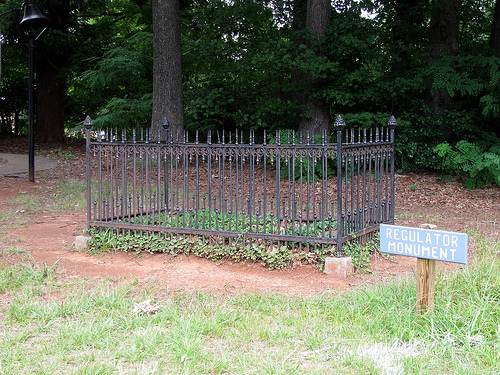
But beneath this calm surface in that location were problems. Just three years earlier at Groovy Alamance Creek, ii,000 Tar Heel farmers called Regulators had led an insurgence, the largest armed rebellion in whatever English colony to that time. They wanted to "regulate" the governor's corrupt local officials, who were charging huge fees and seizing property. The royal governor, William Tryon, and his militia crushed the rebellion at the Battle of Alamance.
Another problem beneath the surface at-home lay with the large African and American Indian populations. Many in these two groups hated their low positions in a society dominated by powerful whites. Some white colonists believed that if a state of war with England broke out, these other Tar Heels would support the king in hopes of gaining more control over their ain lives.
Finally, Tar Heels knew that other colonies were continuing to resist English language command. In 1773, colonists in Boston, Massachusetts, had thrown shipments of tea into the harbor rather than pay Parliament's taxes on the tea. The Boston Tea Party aroused all the colonies against Parliament, which was continuing to show its contemptuousness for the colonists' welfare.
North Carolina and the Continental Congress
In June 1774, the Massachusetts legislature issued a call for all of the colonies to see at Philadelphia to consider these problems. Merely Royal Governor Josiah Martin refused to call a coming together of N Carolina'southward legislature in time to select delegates to go to Philadelphia. So the colony's Whigs (those who favored independence) formed a provincial congress that sent representatives to the Continental Congress in Philadelphia in September.
The Revolution begins in N Carolina
 The motion against English dominion spread speedily. In April 1775 British soldiers, called lobsterbacks because of their cherry coats, and minutemen—the colonists' militia—exchanged gunfire at Lexington and Concord in Massachusetts. Described as "the shot heard round the world," information technology signaled the start of the American Revolution and led to the creation of a new nation.
North Carolina joined the war the following calendar month. In New Bern on May 23, Abner Nash (who afterwards became governor) led a group of Whigs to Tryon Palace to seize the cannon there. Eight days later, Governor Martin became the showtime royal governor in the colonies to abscond part. He sought refuge in Fort Johnston at the mouth of the Greatcoat Fear River. In July he had to leave the fort and fled to the safety of a British ship anchored offshore.
For 8 years the One-time N State was the scene of suffering caused by the war for independence. There were battles and mortality: the Battle of Moore's Creek Bridge in February 1776, the destruction that summer of the Cherokee Indian villages in western Northward Carolina past Patriot leader Griffith Rutherford, and the battles at Kings Mountain and Guilford Courthouse. There were deaths and injuries, terrible shortages of nutrient and warm vesture, destruction and loss of belongings, and constant fear.
Halifax Resolves
While soldiers fought the war on the field, Northward Carolina's public leaders fought for independence, too. In April 1776 Due north Carolina's provincial congress met at Halifax and decided to send a message to the Continental Congress. The grouping called for all the colonies to proclaim their independence from Dandy Britain. These Halifax Resolves were the start official action by any colony calling for a united bulldoze for independence. At present there was no turning dorsum. One time the members of the Continental Congress signed the Declaration of Independence, merely the spilling of much claret would settle the matter.
Tories and Whigs
But North Carolinians were greatly divided. At that place was bitter combat between the Whigs and Tories (those loyal to England), each trying to force the other to their views or at to the lowest degree to finish them from helping the other side. John Adams, who became the 2d president of the United states of america, said that in the Revolution i third of the people were Whigs, 1 third Tories, and i third did non take either side. This was not exactly true for all colonies, of course, and perhaps N Carolina had more than Whigs than Tories.
A New Government
In the midst of war, and with a divided population, N Carolina began trying to create a new government. The king's governor had fled. If the male monarch were no longer the sovereign, the center of authority and order, then who would be? Where would the government come from?
All the colonies faced this problem. They knew about English police and understood almost governors, legislators, and judges. The new "twist" in 1776 was the practice of placing the power of government in the people rather than in a monarch. The questions of how this popular sovereignty would be expressed through elections, and how oft, and who would be eligible to vote, would become areas of considerable debate.
In November 1776 the provincial congress at Halifax met to draft a bill of rights and a constitution and to create a new regime for the state. Outset, the Declaration of Rights was adopted, and on the following day the new constitution was accepted. The Proclamation of Rights guaranteed personal freedoms—the right to choose i'due south course of religious worship, to write and say what one believed, and to hold peaceful public meetings, among others. The constitution provided for a form of government with three equal branches: an executive to run the country government, a legislative to make the laws, and a judicial to enforce the laws. The constitution also had provisions applying to holding public office, voting, and public education.
When the Patriots adopted their pecker of ceremonious rights before they adopted their form of regime, they showed how important individual liberties were to a people who were fighting confronting what they felt was the oppressive government imposed past the king and Parliament.
In both its neb of rights and its constitution, N Carolina—like the other states—showed a deep distrust of government. Tar Heels believed that personal freedoms needed to be stated in writing. They believed that each branch of government had to exist independent of the others and then that a single private or grouping could not accept too much power.
In creating the new government, revolutionary Americans reached their greatest achievement. They decided that sovereignty would lie with the people of the nation, not in any single person (such every bit the rex) or institution (such as Parliament). Commonwealth would be the ideal.
The system devised was not perfect so, nor is it perfect now. But the ideal of "government past the citizens and for the citizens" was the fuel that fired the revolutionary vision of a just guild. It is the ideal that allows for change when the people want change.
For example, in those days, only free men who owned a certain amount of property were immune to vote. Only since and then, the requirement of owning belongings has been dropped. Women are allowed to vote. Slavery was abolished. Now all developed citizens of the United States (with the exception of those who take committed serious crimes) are allowed to vote. Expanding suffrage—the right to vote—to a greater number of people ways that citizens take greater power over their ain government.
Many Tar Heels living in 1776 would be horrified to come across that everyone has the right to vote. Other revolutionaries of the time would be pleased that the democratic regime they created has get strong and works and so well. The great legacy of the American Revolution is that a government was established that immune for debate and differences of opinion. This regime is able to develop and improve as society progresses.
Information technology seems strange and wrong to us today that the men at Halifax could talk near personal freedom and a better regime while holding African Americans in slavery and denying voting and other rights to women and to men without property. Only the dramatic fight for constitutional rights in the 1780s was staged past an all-white, all-male cast.
However much we may question the ideas of some of the founders, we must admit the importance of what they achieved. They adopted the United states Constitution, which created a government based on written principles with the possibility of amendments. Thus, they established a method to achieve fundamental changes in the time to come, such as the abolition of slavery and the expansion of the right to vote.
1 January 1992 | Price, William S., Jr.
szymanskifrooking.blogspot.com
Source: https://www.ncpedia.org/history/usrevolution/reasons
0 Response to "what are the causes that led to the american revolution"
Post a Comment